

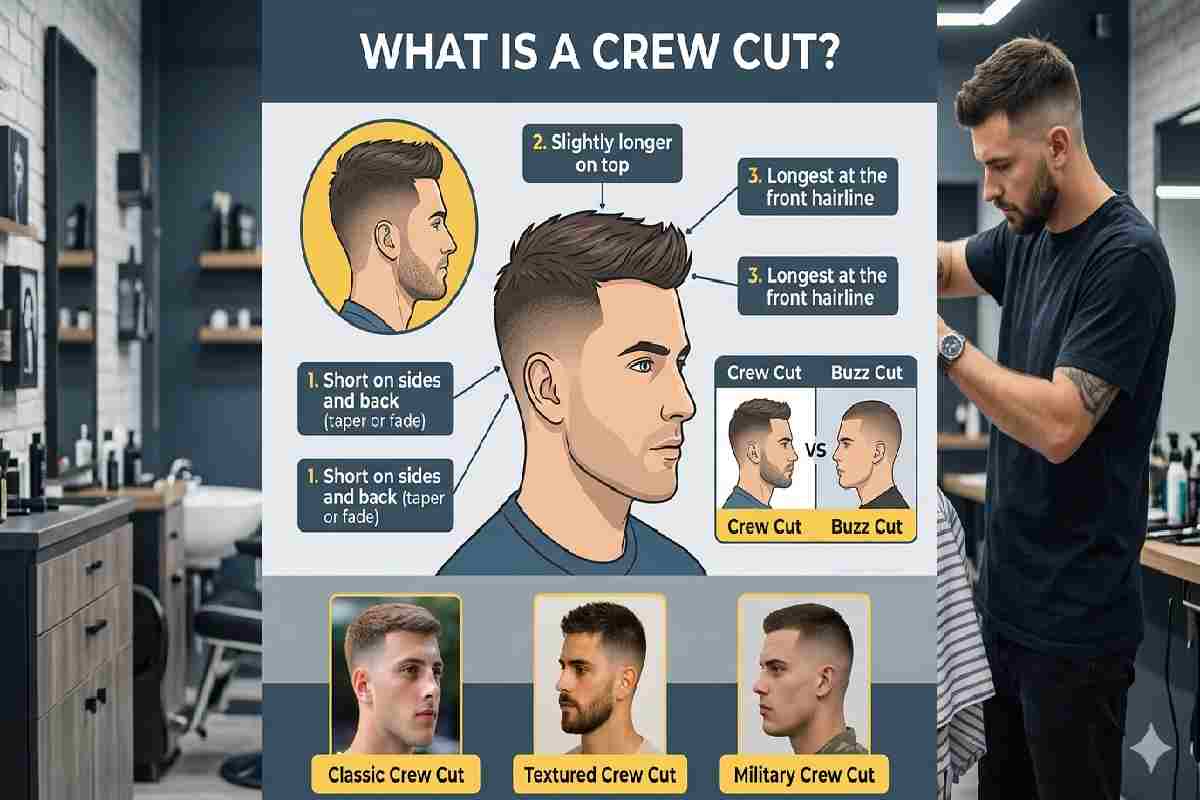

The crew cut remains one of the most popular men’s haircuts for good reason. This low-maintenance, versatile style suits almost every face shape, hair type, and lifestyle. Whether you’re considering your first crew cut or looking for fresh variation ideas, this guide covers everything you need to know.
What is a Crew Cut?
A crew cut is a short men’s haircut characterized by hair on top that stands upright and gradually decreases in length from front to back. The sides and back are tapered or faded, creating a clean, masculine silhouette. Unlike a buzz cut where all hair is uniform length, the crew cut maintains strategic variation that adds dimension and style.
Key Characteristics of a Crew Cut
Every crew cut shares these defining features:
Short, upright top — Hair on top typically measures 1/2 inch to 2 inches, cut short enough to stand up rather than flop over. The front is longest, gradually shortening toward the crown.
Tapered or faded sides — The sides and back are significantly shorter than the top, using clipper guards ranging from #1 to #4. Modern variations often incorporate fades (gradual skin-to-length transitions).
Graduated length — The hallmark of a crew cut is the graduation from longer front to shorter back on top of the head, creating natural dimension.
Low maintenance — The cut requires minimal daily styling, making it ideal for active lifestyles, professional environments, and men who prefer simplicity.
Crew Cut vs Buzz Cut vs Fade
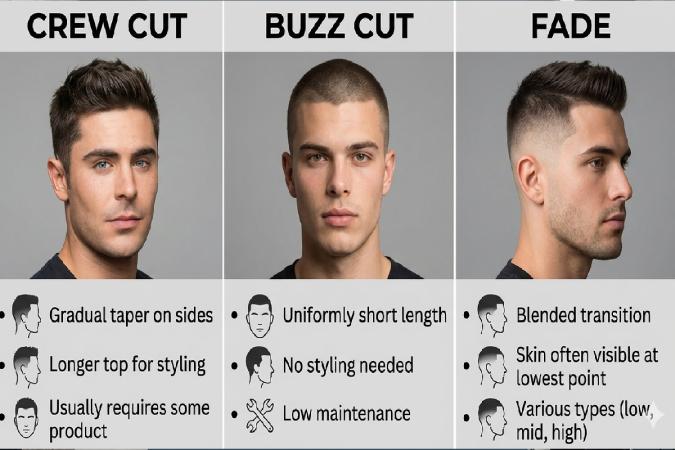
Understanding the differences helps you communicate exactly what you want:
| Feature | Crew Cut | Buzz Cut | Fade |
| Top length | 1/2″ to 2″ (graduated) | Uniform (usually 1/8″ to 1/2″) | Varies (1″ to 4″+) |
| Sides/back | Tapered or faded shorter | Same length as top | Gradual skin-to-length blend |
| Styling needed | Minimal (optional product) | None | Moderate (product usually needed) |
| Maintenance frequency | Every 2-3 weeks | Every 3-4 weeks | Every 1-2 weeks |
| Versatility | High (multiple variations) | Low (one basic look) | Very high (endless combinations) |
| Professional appearance | Excellent | Very formal | Depends on fade height |
Bottom line: A crew cut offers more dimension than a buzz cut but requires less styling than most fade haircuts. It’s the sweet spot for men wanting a polished look without daily effort.
The History Behind the Crew Cut
Origins in Ivy League Rowing
The crew cut earned its name at Yale University in the 1920s and 1930s. Members of the rowing crew teams adopted this practical haircut to keep hair out of their faces during competition. The short, upright style prevented sweat and water from obscuring vision during intense races.
The cut quickly spread to other Ivy League schools, becoming synonymous with collegiate athleticism and East Coast prep culture. This association gave the crew cut an air of refinement that separated it from purely utilitarian military cuts.
Military Adoption and Popularity
During World War II, the U.S. military standardized short haircuts for practical and hygienic reasons. The crew cut became one of the approved styles, alongside the even shorter buzz cut. Soldiers appreciated how the crew cut maintained a bit of personality while meeting military standards.
Post-war, millions of veterans returned home with crew cuts, normalizing the style in civilian life. Throughout the 1950s, the crew cut represented clean-cut American masculinity, appearing in movies, advertisements, and family photos.
The Crew Cut in Modern Men’s Fashion
Today’s crew cut has evolved beyond its military and athletic roots. Modern barbering techniques now combine the classic crew cut structure with contemporary elements like high fades, textured tops, and hard parts.
The style appeals to professional men seeking polished appearance, athletes wanting functional haircuts, and style-conscious guys appreciating classic aesthetics. Celebrities, athletes, and influencers regularly sport crew cut variations, keeping the style relevant across generations.
25 Popular Crew Cut Styles and Variations
The crew cut’s versatility shines through its many variations. Here are the most popular styles to consider:
Classic Crew Cut
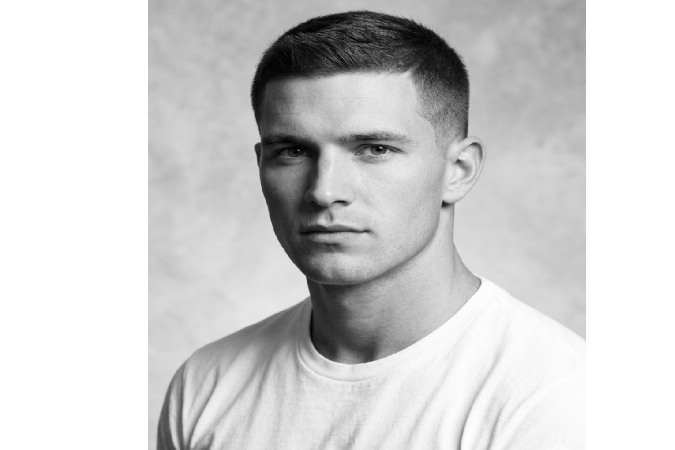
The original: hair on top measures about 1 inch at the front, gradually decreasing to 1/4 inch at the crown. Sides are tapered using a #3 or #4 guard, blending smoothly into the top. This timeless style works in any professional environment and requires zero styling.
Best for: Traditional tastes, professional environments, low-maintenance preferences
Crew Cut with Fade (High, Mid, Low)
Adding a fade creates modern edge while maintaining crew cut structure:
High fade — Fade begins above the temples, creating maximum contrast and a bold, contemporary look. Elongates round faces.
Mid fade — Fade starts at temple level, offering balance between classic and trendy. The most versatile fade option.
Low fade — Fade begins just above the ears, providing subtle modernization while keeping a conservative appearance.
Best for: Guys wanting modern style, those with thick hair on sides, fashion-forward professionals
Ivy League Crew Cut

Also called the Harvard Clip or Princeton, this variation keeps extra length on top (1.5 to 2 inches), allowing for a side part. It bridges the gap between a crew cut and traditional parted styles, offering more styling versatility.
Best for: Professional settings requiring refined appearance, men wanting styling options, those with straighter hair
High and Tight Crew Cut
Military-inspired with dramatic contrast: the top measures 1/2 to 1 inch while sides are buzzed down to a #1 or #2 guard, sometimes to the skin. Creates an aggressive, no-nonsense aesthetic.
Best for: Athletic builds, military/law enforcement personnel, men with strong facial features, very low maintenance needs
Textured Crew Cut
Barbers use texturizing shears or razors to create dimension and remove bulk on top. This adds a modern, slightly messy appearance while maintaining crew cut structure. Works especially well with thick or coarse hair.
Best for: Thick hair, casual style preferences, younger men, adding visual interest
Messy Crew Cut
Requires slightly more length on top (1.5 to 2 inches) styled with matte product for deliberate, tousled texture. This contemporary take balances polished sides with casual, lived-in top.
Best for: Creative professionals, casual environments, men comfortable with daily styling
Crew Cut for Thinning Hair
Keeping the top shorter (around 3/4 inch) minimizes the appearance of thinning by reducing contrast between hair and scalp. A mid or low fade on sides draws eyes away from the crown.
Best for: Receding hairlines, thinning crowns, older men, embracing natural aging
Crew Cut for Curly Hair
Natural curl adds automatic texture and volume. Keeping top length around 1 to 1.5 inches allows curls to show character while maintaining crew cut shape. Sides should be faded fairly short to prevent mushroom silhouette.
Best for: Natural curls or waves, embracing texture, adding volume
Long Crew Cut
Pushes traditional boundaries with 2 to 2.5 inches on top. Still maintains front-to-back graduation but allows more styling flexibility. Borders on becoming an Ivy League or short pompadour.
Best for: Men transitioning from longer styles, those wanting maximum crew cut versatility, professional environments allowing personal expression
Short Crew Cut
Conservative approach with top measuring just 1/2 to 3/4 inch. Nearly approaches buzz cut territory but maintains subtle graduation. Extremely low maintenance.
Best for: Hot climates, very active lifestyles, military/uniformed professions, maximum simplicity
Crew Cut with Hard Part
A shaved line creates a precise part on one side, adding modern detail to classic structure. The hard part ranges from subtle to dramatic depending on width and placement.
Best for: Adding personality to conservative cuts, younger professionals, men with straight hair
Crew Cut with Line Up
A crisp, defined hairline at the forehead and temples creates sharp, angular framing. Popular in urban barbering and hip-hop culture, this adds precision to the crew cut silhouette.
Best for: Younger men, urban style preferences, darker hair (shows contrast better)
Additional Crew Cut Variations:
- Crew cut with taper — Gradual length change without skin fade
- Butch cut — Uniform top length, similar crew cut sides
- Flat top crew cut — Top cut horizontally flat across
- Burr cut — Very short variation between crew and buzz
- Crew cut with beard — Pairing for balanced facial grooming
- Side-swept crew cut — Longer front combed to one side
- Crew cut with design — Shaved patterns in fade area
- Undercut crew cut — Disconnected sides for maximum contrast
- Crew cut fade with waves — For naturally wavy hair texture
- Executive crew cut — Polished Ivy League-style variation
- Summer crew cut — Shorter seasonal variation for heat
- Crew cut with quiff — Extra front height for modern edge
- Skin fade crew cut — Sides faded to skin for boldest look
Is a Crew Cut Right for You?
Best Face Shapes for Crew Cuts
The crew cut’s versatility means it works for most face shapes, but certain variations optimize different features:
Oval face — The golden face shape suits any crew cut variation. You have complete freedom to choose based on personal style preference rather than facial balance.
Round face — High fades and longer tops elongate round faces. Avoid uniform short lengths that emphasize face roundness. Add height on top to create vertical lines.
Square face — Classic crew cuts complement strong jawlines. Textured tops soften angular features. Avoid extremely short buzz-like crews that overemphasize squareness.
Diamond face — Balanced crew cuts with mid fades work perfectly. Your wide cheekbones pair well with the clean structure. Classic and Ivy League variations are ideal.
Rectangle/oblong face — Low fades and shorter tops prevent further elongation. Avoid high fades and excessive top height. Keep proportions balanced.
Heart/triangle face — Fuller tops balance narrower jaws. Textured and messy crew cuts add width up top. Mid to low fades work best.
Crew Cuts for Different Hair Types
Thick hair — Excellent for crew cuts. Ask for texturizing to remove bulk. Shorter tops (3/4 to 1 inch) prevent puffiness. Texture adds dimension.
Thin/fine hair — Crew cuts can create the illusion of thickness by minimizing scalp contrast. Keep length moderate (1 to 1.5 inches) and use volumizing products. Avoid going too short.
Curly hair — Natural texture shines in textured crew cuts. Leave enough length (1 to 1.5 inches) for curls to form. Fade sides short to avoid rounded silhouettes.
Wavy hair — Ideal for crew cuts. Waves add natural texture and movement. 1 to 2 inches on top allows waves to show personality.
Straight hair — Perfect for classic, clean crew cuts. Holds shape well with minimal product. Works across all crew cut variations.
Receding hairline — Shorter crew cuts (under 1 inch) minimize recession appearance. Avoid dramatic length contrast. Consider textured tops for distraction.
Age Considerations for Crew Cuts
Teens and 20s — Modern variations (fades, hard parts, texture) allow self-expression while maintaining acceptable school/entry-level professional standards.
30s and 40s — Classic and Ivy League crew cuts project professional maturity. Practical for balancing career demands with personal upkeep.
50s and beyond — Crew cuts gracefully accommodate thinning hair and graying. Shorter variations embrace natural aging with dignity and style.
Lifestyle and Maintenance Requirements
Crew cuts excel in low-maintenance scenarios:
Active lifestyles — Athletes, gym-goers, and outdoor enthusiasts appreciate how crew cuts handle sweat and remain neat without fuss.
Professional requirements — Most corporate, military, education, and service industries accept or encourage crew cuts as appropriately groomed.
Time constraints — Busy professionals and parents benefit from the 30-second styling routine (or zero styling for shorter versions).
Climate considerations — Hot, humid climates favor shorter crew cuts for comfort. Cold climates may prefer slightly longer variations.
Budget consciousness — While requiring regular trims, crew cuts use minimal product, balancing costs over time.
How to Ask Your Barber for a Crew Cut
Clear communication ensures you get the crew cut you envision.
Essential Terms to Know
Taper — Gradual decrease in hair length, usually starts mid-head down to neckline.
Fade — More dramatic gradual blend, often to skin. Specified as high, mid, or low based on where blending begins.
Clipper guard numbers — #1 = 1/8 inch, #2 = 1/4 inch, #3 = 3/8 inch, #4 = 1/2 inch. Higher numbers mean more length.
Graduation — The front-to-back length decrease that defines crew cuts.
Blend — Smooth transition between different lengths without visible lines.
Specifying Length and Fade Type
Be specific with measurements:
TOP: “I want one inch at the front, graduating to half an inch at the crown.”
SIDES: “Take the sides down with a #2 guard.”
FADE: “Give me a mid fade starting at temple level, blending down to a #1.”
BACK: “Clean up the neckline, tapered/blocked.” (Tapered is rounded, blocked is squared off)
Bringing Reference Photos
Pictures eliminate guesswork. Save 2-3 photos showing:
- Front view of the hairstyle
- Side view showing fade/taper height
- Top view if possible
Tell your barber: “I like this overall style, but I want [specific modification].”
Communicating Your Hair Goals
Share context beyond the cut itself:
“I need something professional for my job but easy to maintain.”
“I’m growing out a buzz cut and want the next step toward a crew cut.”
“My hair is thinning on top, so I want length that minimizes that.”
“I style my hair every morning, so I’m fine with something requiring product.”
Good barbers appreciate this information and can tailor the cut accordingly.
How to Style a Crew Cut
One of the crew cut’s biggest advantages is simple styling.
Basic Crew Cut Styling Steps
For shorter crew cuts (under 1 inch):
- Wash and towel dry
- Done. Seriously, that’s it.
For longer crew cuts (1+ inches):
- Start with damp (not soaking) hair after washing
- Rub a dime-sized amount of product between palms
- Work product through top hair with fingers
- Direct hair upward and slightly forward or to the side
- Use fingertips to create texture if desired
- Let air dry or blow dry briefly for more hold
- Optional: Light hairspray mist for all-day hold
Best Products for Crew Cuts
Matte pomade or clay — Best for textured, natural-looking hold. Provides control without shine. Ideal for messy or textured crew cuts.
Styling cream — Light hold with slight sheen. Perfect for professional, polished crew cuts that need structure without looking styled.
Fiber or paste — Strong hold with flexibility. Good for longer crew cuts or Ivy League styles requiring all-day shape retention.
Sea salt spray — Adds texture and volume to wavy or curly crew cuts. Apply to damp hair before styling.
Light gel — For crew cuts needing maximum hold (athletic activities, formal events). Apply sparingly to avoid crunchiness.
Texturizing powder — Lifts fine hair and adds grip. Perfect for thin-haired guys wanting fuller-looking crew cuts.
Professional vs Casual Styling
Professional styling:
- Use minimal product for natural appearance
- Direct hair straight up or slightly forward
- Keep texture subtle and uniform
- Ensure clean, even distribution
Casual/weekend styling:
- Embrace more texture and messiness
- Use matte products for lived-in look
- Allow natural cowlicks and imperfections
- Consider directional styling (side-swept, pushed back)
Styling Tips for Different Hair Textures
Thick hair — Use clay or heavy pomade to control bulk. Apply to damp hair for easier distribution.
Thin hair — Powder or light cream adds volume without weighing down. Apply to dry or nearly-dry hair.
Curly hair — Light cream or leave-in conditioner defines curls without frizz. Scrunch product in gently.
Straight hair — Nearly any product works. Clay or paste for texture, cream for smooth polish.
Wavy hair — Sea salt spray enhances natural wave pattern. Apply to damp hair and scrunch.
Crew Cut Maintenance Guide
How Often to Get Trims
Shorter crew cuts (under 1 inch): Every 2 weeks to maintain shape and fade crispness.
Standard crew cuts (1 to 1.5 inches): Every 3 weeks keeps the style looking fresh.
Longer crew cuts/Ivy League: Every 4 weeks, as extra length tolerates growth better.
Faded crew cuts: Every 2 to 3 weeks, as fades grow out noticeably faster than tapers.
Missing appointments by a week or two won’t ruin your look, but regular schedules maintain the polished crew cut aesthetic.
DIY Touch-Ups Between Barber Visits
Extend time between cuts with simple home maintenance:
Neckline cleanup:
- Use trimmers with a guard or carefully freehand
- Clean only the very bottom 1/2 inch below your natural neckline
- Don’t go higher or you’ll create visible lines
Sideburn trimming:
- Keep electric trimmers handy
- Trim sideburns to consistent length
- Use your tragus (ear cartilage bump) as a reference point
Around the ears:
- Carefully trim hair growing over ears
- Use small scissors or trimmers without a guard
- Go slowly to avoid cutting skin
WARNING: Don’t attempt to fix the fade or cut the top yourself unless you have experience. These areas are best left to professionals.
Daily Hair Care Routine
Morning:
- Rinse with water (or wash if you produce excess oil)
- Apply minimal product to damp hair
- Style in 30 seconds or less
Evening:
- No specific routine needed for shorter cuts
- Longer styles may benefit from a quick brush to prevent weird sleep patterns
2-3 times per week:
- Wash with quality shampoo suited to your hair type
- Use conditioner if your scalp tends toward dryness
- Exfoliate scalp weekly to prevent buildup and flaking
Seasonal Crew Cut Care
Summer:
- Consider going slightly shorter for heat management
- Use sunscreen or wear a hat to prevent scalp sunburn
- Increase washing frequency if you sweat more
Winter:
- Slightly longer crew cuts provide modest warmth
- Combat indoor heating dryness with light leave-in conditioner
- Wear beanies that won’t flatten your style (loose-knit styles work well)
Common Crew Cut Problems and Solutions
Dealing with Cowlicks
The problem: Hair grows in a circular pattern, causing sections to stick up or go sideways.
Solutions:
- Work WITH the cowlick direction when styling
- Use stronger-hold products in that specific area
- Ask your barber to cut cowlick areas slightly shorter
- Blow dry while brushing against cowlick direction to train it flat
Managing Awkward Growth Stages
The problem: The cut looks great fresh but weird after 3-4 weeks.
Solutions:
- Schedule regular appointments before awkwardness hits
- Ask your barber to cut the style to “grow out well”
- Use more product during the 3rd and 4th weeks
- Consider a slightly longer variation that tolerates growth better
Fixing an Uneven Cut
The problem: One side looks shorter, fade is uneven, or top has choppy sections.
Solutions:
- Return to your barber within a few days (most fix issues free)
- If switching barbers, bring a photo of the unevenness
- For minor unevenness, styling product can camouflage until next cut
- Learn what good work looks like so you can identify poor execution early
Addressing Scalp Visibility
The problem: Scalp shows through hair, especially under harsh lighting.
Solutions:
- Keep crew cuts on the slightly longer side (1 to 1.5 inches)
- Use volumizing products that lift hair away from scalp
- Consider textured variations that create visual density
- Embrace it – many modern crew cuts intentionally show some scalp
Crew Cut Cost Expectations
Average Pricing at Different Salon Types
Budget barbershops/chains: 25
- Basic crew cuts executed competently
- Limited fade complexity
- Quick service (15-20 minutes)
Mid-range barbershops: 50
- Better fade work and attention to detail
- More time spent (30-40 minutes)
- Consultative approach to styling
Premium barbershops/salons: 100+
- Master barber expertise
- Precision fades and custom styling
- Full service experience (hot towel, shoulder massage, etc.)
Location matters: Urban areas and high-cost-of-living cities charge 30-50% more than suburban or rural areas.
Product Investment Requirements
Minimal setup: 30
- One styling product (clay, pomade, or cream): 20
- Basic shampoo: 15
- Total: 35
Complete setup: 100
- Quality shampoo: 25
- Conditioner: 25
- Styling product: 25
- Texturizing spray or powder: 25
- Home trimmers for touch-ups: 60
Monthly product costs: 15 depending on how frequently you wash and style.
Long-Term Cost Comparison
Annual crew cut costs:
- Cuts every 3 weeks: 17 cuts/year
- At 595/year
- Products: 150/year
- Total: 745/year
Compared to longer styles:
- Cuts every 6-8 weeks: 6-8 cuts/year
- At 240-$320/year
- Products: 250/year (more product needed)
- Total: 570/year
Crew cuts cost MORE over time due to frequent trims, but save time and hassle. Consider the time-cost trade-off based on your priorities.
Frequently Asked Questions About Crew Cuts
Q: What is a crew cut?
A: A crew cut is a short men’s haircut where hair on top stands upright and gradually decreases in length from front to back, with tapered or faded sides. Top length typically ranges from 1/2 inch to 2 inches, creating a clean, low-maintenance style.
Q: What’s the difference between a crew cut and a buzz cut?
A: A buzz cut uses the same clipper guard length all over the head for uniform shortness. A crew cut has graduated length on top (longer at front, shorter at back) with tapered sides, creating more dimension and style variation.
Q: What face shape suits a crew cut best?
A: Crew cuts suit almost all face shapes, especially oval, square, and diamond shapes. Round faces benefit from high fades and longer tops for elongation. Rectangle faces should avoid excessive top height. Heart-shaped faces look great with textured, fuller tops.
Q: How often should I trim my crew cut?
A: Every 2-3 weeks for optimal appearance. Shorter crew cuts and faded styles need more frequent trims (every 2 weeks), while longer variations can go 3-4 weeks between appointments.
Q: Can I get a crew cut with thinning or receding hair?
A: Yes, crew cuts actually work very well for thinning hair. Keeping the top relatively short (3/4 to 1 inch) minimizes contrast between hair and scalp. Textured variations add visual density. Many men find crew cuts boost confidence as hair thins.