


The size of the face is oblong, the face is long and wide with the proportions in the forehead, cheekbones, and jaw being equal. Whether you have had issues identifying your face shape or are unsure how to wear it in the most flattering way, this guide offers evidence-based methods to it and recommendations approved by the specialists.
Arguably, the key to successful oblong face styling is comprehending your shape, which provides you with the ability to design a visual balance, highlight your innate beauty, and build confidence. We shall explore techniques of identification, rules of styling and tips that work in practice supported by professional stylists and real-life examples.
What is an Oblong Face Shape?
A long face or Olong face is a shape of face characterized by vertical focus. The length of the face is much longer than the width, and it is usually 1.5:1 to 2:1 or higher.
Key Characteristics of Oblong Faces
The following are the distinguishing features on oblong faces:
Length dominance: Face is significantly longer than it is wide, the distance between the hairline and the chin.
Equal width measurements: The forehead, cheekbones and jawline are approximately equal in width.
Roundness of features: Chin and jaw are not sharp, but rounded.
High or prominent forehead: Uses up a lot of space as compared to other facial features.
Straight cheek lines: Little tapering of the temples to the jaw.
Narrowness of overall appearance: Face is thin on the front.
Oblong vs Oval vs Rectangle: Understanding the Differences
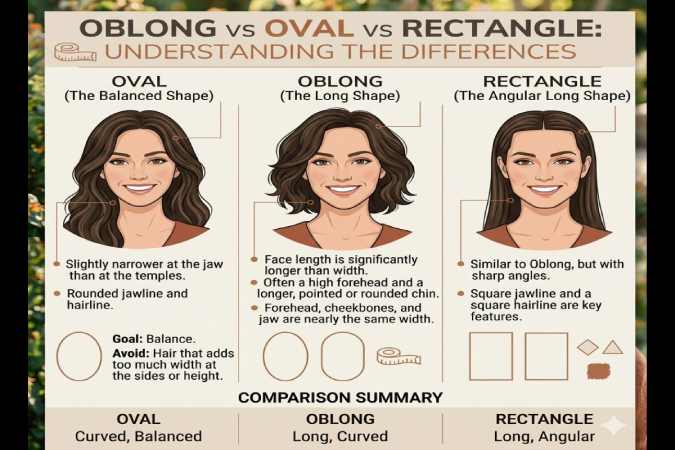
Confusion between these three shapes is common. Here’s the definitive breakdown:
Oblong Face:
- Length is 1.5-2x the width
- Rounded, soft jawline and chin
- Equal width across forehead, cheeks, and jaw
- Appears elongated with gentle curves
Oval Face:
- Length is approximately 1.5x the width (more balanced than oblong)
- Widest at cheekbones, narrower at forehead and jaw
- Considered the “ideal” proportionate face shape
- More curved outline overall
Rectangle Face:
- Similar length-to-width ratio as oblong (1.5-2x)
- Angular, square jawline (key difference from oblong)
- Strong, defined features
- More masculine appearance
Quick distinction: If your jawline is rounded, you’re oblong. If it’s angular and squared, you’re rectangular.
How to Identify Your Oblong Face Shape
Accurate identification prevents styling mistakes and helps you apply the right techniques.
The 3-Step Measurement Method
What you need: A flexible measuring tape, mirror, and hair pulled back
1: Measure Face Length
- Measure from the center of your hairline straight down to the tip of your chin
- Record this number (e.g., 9 inches)
2: Measure Face Width
- Measure across your cheekbones at the widest point (typically just below the outer corner of your eyes)
- Record this number (e.g., 5 inches)
3: Calculate the Ratio
- Divide length by width: 9 ÷ 5 = 1.8
- If ratio is 1.5 or higher, you likely have an oblong face
- If ratio is 1.3-1.5, you likely have an oval face
- If ratio is below 1.3, consider round or square shapes
Additional check: Measure your forehead width, cheekbone width, and jawline width. If all three are within 0.5 inches of each other, oblong is confirmed.
Visual Indicators Without Measuring
Not a fan of tape measures? Look for these visual cues:
You have an oblong face if:
- Your face looks noticeably longer when you pull hair completely back
- The distance from eyes to chin appears similar to the distance from hairline to eyes
- Your forehead, cheeks, and jawline appear roughly equal in width
- Your chin is softly rounded, not pointed or square
- People describe your face as “long” or “narrow”
You probably DON’T have an oblong face if:
- Your cheekbones are noticeably wider than your forehead
- Your face appears as wide as it is long
- You have a pronounced, angular jawline
Common Misidentification Mistakes
1: Confusing Oblong with Oval
- Many people with oblong faces identify as oval because both have balanced proportions
- Solution: Focus on the length ratio—oblong is significantly longer
2: Assuming All Long Faces Are Oblong
- Heart-shaped faces can also appear long but have a wider forehead
- Solution: Check if your forehead, cheeks, and jaw are equal width
3: Ignoring Soft vs Angular Features
- Rectangle faces are equally long but have angular jaws
- Solution: Look at your jawline—rounded = oblong, squared = rectangle
Is Oblong Face Shape Attractive?
Absolutely. The oblong face shape is associated with elegance, sophistication, and striking features. The elongated proportions create a naturally refined appearance.
Advantages of Oblong Face Proportions
Modeling Industry Favorite: Oblong faces photograph exceptionally well due to their defined bone structure and balanced width proportions.
Versatile Styling Options: Unlike extreme shapes (very round or very square), oblong faces can pull off a wide range of hairstyles, glasses, and accessories with minor adjustments.
Aging Gracefully: The elongated structure tends to show less facial sagging over time, as there’s more vertical real estate for skin to distribute naturally.
Sophisticated Aesthetic: The length creates an inherently elegant, regal appearance that conveys confidence and poise.
Celebrities Who Rock the Oblong Face Shape
Women:
- Sarah Jessica Parker: Masters volume at the sides with her iconic curly styles
- Liv Tyler: Uses soft, face-framing layers to add width
- Hilary Swank: Favors textured waves and side parts
- Joan Smalls: Embraces blunt cuts that create horizontal emphasis
- Blake Lively: Demonstrates how long hair can work with proper texturing
Men:
- Keanu Reeves: Balances length with medium-length textured styles
- Ryan Gosling: Uses side-swept styles and subtle facial hair
- Paul Rudd: Maintains fuller sides with controlled top volume
- Eddie Redmayne: Employs soft, side-parted styles
- Shawn Mendes: Demonstrates youthful, textured approaches
Best Hairstyles for Oblong Face Shape
The golden rule for oblong faces: add width, control height.
Hairstyle Goals: Adding Width and Balance
Your styling objectives should include:
- Create horizontal emphasis: Styles that widen the appearance at cheekbone and temple level
- Shorten perceived length: Bangs, fringes, or layering that breaks up vertical lines
- Add volume at the sides: Fullness that balances the narrow width
- Avoid excessive top height: No towering pompadours or high top knots
Top Haircuts for Women with Oblong Faces
1. Shoulder-Length Lob with Side-Swept Bangs
- Why it works: Creates width at mid-face, bangs shorten forehead
- Best for: Straight to wavy hair
- Celebrity example: Hilary Swank
2. Curly Shag with Volume
- Why it works: Natural volume adds width throughout
- Best for: Naturally curly or wavy hair (2B-3C curl types)
- Styling tip: Avoid smoothing curls flat—embrace the volume
3. French Bob (Chin-Length)
- Why it works: Blunt cut creates strong horizontal line at jaw
- Best for: Fine to medium hair density
- Celebrity example: Joan Smalls’s jellyfish cut variation
4. Layered Mid-Length Cut (Collarbone)
- Why it works: Layers create outward movement and width
- Best for: All hair textures
- Styling tip: Curl or wave outward, not inward
5. Curtain Bangs with Long Layers
- Why it works: Face-framing pieces add width, layers prevent hair from hanging straight
- Best for: Straight to wavy hair
- Celebrity example: Blake Lively
6. Textured Pixie with Side Bangs
- Why it works: Volume at sides, bangs shorten face
- Best for: Thick hair that holds texture
- Avoid: Ultra-short pixies without side volume
7. Wavy Lob with Deep Side Part
- Why it works: Side part prevents vertical line, waves add dimension
- Best for: Naturally wavy or heat-styled straight hair
Best Haircuts for Men with Oblong Faces
1. Side-Parted Medium Length
- Why it works: Creates horizontal movement, controlled top volume
- Best for: Straight to wavy hair
- Celebrity example: Ryan Gosling, Keanu Reeves
2. Textured Crop with Fuller Sides
- Why it works: Keeps top short (1-2 inches), maintains fuller sides
- Best for: Thick, straight hair
- Styling tip: Use matte clay for texture, not height
3. French Crop with Fringe
- Why it works: Forward fringe shortens forehead, blunt cut adds weight
- Best for: Fine to medium hair
- Product tip: Light pomade for hold without shine
4. Wavy Medium Cut
- Why it works: Natural wave creates width, breaks up length
- Best for: Naturally wavy hair (2A-2C)
- Celebrity example: Eddie Redmayne
5. Short Sides with Textured Top (Moderate)
- Why it works: Balances proportions when top is kept to 2-3 inches max
- Best for: Versatile across textures
- Avoid: High fades or excessive top length (4+ inches)
6. Crew Cut with Soft Edges
- Why it works: Even length distribution, no vertical emphasis
- Best for: Low-maintenance preference
- Keep in mind: Requires frequent trims (every 3-4 weeks)
7. Side-Swept Undercut (Subtle)
- Why it works: Creates diagonal line, side volume
- Best for: Thick hair that can hold a side sweep
- Avoid: Slicking it straight back
Bangs and Fringe Options
Bangs are highly recommended for oblong faces as they visually shorten the forehead.
Best bang styles:
- Curtain bangs: Soft, face-framing, creates width
- Side-swept bangs: Asymmetry breaks up length
- Blunt bangs (eyebrow-grazing): Strong horizontal line
- Wispy bangs: Softer alternative for fine hair
- Textured fringe (men): Forward or side-swept
Avoid:
- Baby bangs (too short, expose forehead)
- Heavy, straight-across bangs that are too thick (can overpower)
Hair Length Considerations
Short hair (above shoulders/ears):
- Works well if volume is at the sides
- Avoid if all volume is on top (adds height)
Medium length (shoulder to collarbone):
- Ideal for oblong faces—creates width at perfect level
- Add layers, waves, or texture
Long hair (below collarbone):
- Can work with proper styling (waves, volume, layers)
- Avoid if worn straight and flat—elongates face further
- Pro tip: Add texture, side part, and horizontal layers
Hairstyles to Avoid with Oblong Faces
Avoid these styles that exaggerate length:
Styles That Elongate Your Face
Slicked-back hair: Exposes full face length, adds no width
High top knots/buns: Adds vertical height
Center parts (especially with straight hair): Creates strong vertical line down center
Ultra-long, straight hair without texture: Emphasizes length
High pompadours or quiffs: Excessive top volume
Buzz cuts with no facial hair: Exposes entire face structure without balance Tight ponytails pulled straight back: Shows full elongation
Common Styling Mistakes
Assuming “add volume” means adding height
- Fix: Volume should be horizontal (at sides), not vertical (on top)
Choosing styles based on trends rather than face shape
- Fix: Adapt trending styles to suit your proportions (e.g., lower a quiff, add side texture to a bob)
Over-straightening naturally textured hair
- Fix: Embrace natural texture—it adds beneficial width
Neglecting regular trims
- Fix: Oblong faces need shape maintenance every 6-8 weeks to prevent length from overtaking width
Makeup Tips for Oblong Face Shape
Strategic makeup application creates the illusion of a shorter, wider face.
Contouring Techniques to Shorten the Face
Goal: Recede the forehead and chin to reduce perceived length
1 – Forehead Contour:
- Apply matte bronzer or contour powder along the hairline at the top of the forehead
- Blend downward in a soft arc
- Focus on the center-top of the forehead, not the temples
2 – Chin Contour:
- Apply contour to the bottom of the chin (just below the lip to the underside of the jaw)
- Blend in small circular motions
- This visually “cuts off” excess length
3 – Under-Cheekbone Contour:
- Apply contour in the hollow beneath cheekbones
- Blend upward and outward toward temples (not downward)
- This adds dimension without lengthening
Avoid: Contouring along the sides of the face (temples to jaw)—this narrows an already narrow face
Blush Placement for Added Width
Technique:
- Apply blush to the apples of the cheeks in a circular motion
- Extend blush outward horizontally toward the temples
- Use a fluffy brush for diffused application
Color strategy:
- Warm undertones: Peach, coral, warm pink
- Cool undertones: Rose, mauve, berry tones
- Deeper skin tones: Terracotta, deep berry
Pro tip: Add a subtle highlight to the very top of cheekbones to create a lifting effect and add width
Eye Makeup Strategies
Emphasizing your eyes draws attention to the center of the face, balancing proportions.
Techniques that work:
- Horizontal eye shapes: Cat-eye liner that extends outward
- Bold eyeshadow: Dramatic colors or smokey eyes create focal points
- Extended liner: Wing liner past the outer corner
- Lower lash emphasis: Liner or shadow on lower lash line widens the eye area
Avoid:
- Excessive vertical eyeshadow application (tall gradients)
- Overly arched brows that add height
Eyebrow Shaping for Oblong Faces
Ideal brow shape: Straighter brows with a soft, subtle arch
Why it works: Horizontal brow lines create width; high arches add unwanted height
Styling guidelines:
- Extend brows slightly beyond the outer eye corner (adds horizontal emphasis)
- Keep the arch low and gradual
- Maintain fuller brows rather than thin, arched shapes
- Avoid overly rounded or highly arched shapes
Best Glasses and Eyewear for Oblong Faces
The right frames can transform your proportions instantly.
Frame Shapes That Flatter
- Oversized Frames
- Why: Large frames add horizontal emphasis and create visual interruption
- Styles: Oversized square, wide rectangular, large round
- Aviator Styles
- Why: Teardrop shape creates width at temples
- Best: Classic metal or acetate aviators with standard or slightly wider bridge
- Cat-Eye Frames
- Why: Upswept outer corners add width at temple level
- Best for: Women seeking a vintage or bold aesthetic
- Wayfarer-Style Frames
- Why: Rounded rectangular shape balances length
- Best: Wider wayfarers, avoid narrow versions
- Decorative Temple Frames
- Why: Embellishments or bold temple designs add width perception
- Look for: Frames with distinct hinge details, colored temples, or patterns
Frame Sizes and Proportions
Key measurement: Frame width should be proportionate to your face width—go for medium to large sizes
Bridge consideration: Medium to wider bridges help add horizontal emphasis
Temple length: Standard to slightly longer temples with decorative elements
Styles to Avoid
Narrow rectangular frames: Emphasize length Small round frames: Don’t provide enough width balance Rimless or minimal frames: Lack visual weight to create balance Frames with excessive vertical height: Add to face length
Accessories and Styling Tips
Beyond hair and makeup, accessories play a crucial role in balancing oblong proportions.
Earrings for Oblong Faces
Best styles:
- Round or circular drops: Create width at jaw level
- Short chandelier earrings: Add horizontal interest without excessive length
- Fan-shaped or triangular: Wide at bottom
- Oval or teardrop (short): Gentle curves that don’t elongate
Avoid:
- Long, linear drop earrings (add vertical lines)
- Thin, dangly styles without width
Necklaces and Collars
For necklaces:
- Chokers or collar-length: Create horizontal line near face
- Wide statement necklaces: Add visual width
- Layered shorter necklaces: Multiple horizontal lines
Avoid:
- Long pendant necklaces that create a vertical drop
- V-shaped necklaces that emphasize length
For collars (men’s shirts):
- Spread collars: Create width at neck
- Button-down collars: Moderate spread
- Cutaway collars: Maximum horizontal emphasis
Avoid:
- Point collars (create V-shape downward)
- Narrow collars
Hats and Headwear
Best choices:
- Wide-brimmed hats: Fedoras, wide sun hats create horizontal lines
- Bowler hats: Rounded shape with moderate brim
- Cloche hats: Vintage style that adds width
Avoid:
- Tall crowns without brims (top hats, high beanies worn high)
- Narrow, elongated styles
Facial Hair Styling for Oblong Face Shape (Men)
Strategic facial hair adds crucial width and shortens the perceived face length.
Beard Styles That Add Width
- Full Beard with Rounded Bottom
- Length: Medium (6-10mm)
- Shape: Keep sides fuller, round the bottom edge
- Why it works: Adds horizontal emphasis at jaw, shortens chin-to-hairline distance
- Short Boxed Beard
- Length: Short (3-5mm)
- Shape: Clean lines with width at sides
- Why it works: Defines jaw width without adding length
- Mutton Chops or Extended Sideburns
- Length: Varies
- Shape: Extends sideburns down to mid-cheek or jawline
- Why it works: Adds significant width at cheek level
- Balbo or Anchor Beard
- Style: Disconnected chin beard with mustache
- Why it works: Focuses attention on the lower third, creates horizontal interest
Mustache Considerations
Recommended styles:
- Chevron mustache: Full, wide coverage
- Walrus mustache: Adds width and shortens upper face
- Handlebar (subtle): Width at ends
Avoid:
- Thin pencil mustaches (too narrow)
- Fu Manchu (adds vertical lines)
Grooming Maintenance Tips
- Trim beard bottom every 1-2 weeks to maintain rounded shape
- Keep cheek lines natural (not too high) to avoid lengthening
- Use beard oil to maintain fullness and prevent thinning
- Shape sideburns to add width at temple level
Pro tip: If you can’t grow a full beard, even 2-3 days of stubble strategically maintained can add beneficial width.
Common Questions About Oblong Face Shapes
But in what way do I know whether my face is oblong?
Measuring face length and width. When the length of your face is 1.5 times or higher than the width, and the forehead, cheekbones, and jaw are more or less equal in their widths, then you have an oblong face. Also, in case of a rounded (not angular) jawline, oblong is affirmed instead of rectangular.
How can the shapes of oblong and oval faces differ?
They both are longer than wide, although otherwise oblong faces are longer than wide with a higher length-to-width ratio (1.5-2:1+) than oval faces (about 1.3-1.5:1). The widest part of the oval faces is also along the cheekbones and has a tendency to wear-down towards the forehead and jaw with oblong faces maintaining the same width throughout all three places.
Does an oblong face shape mean that it is attractive?
Yes. The oblong face is very popular in the fashion and modelling market due to their graceful curves and prominent contentment of the bone structure. Most of the models and actors who have succeeded are oblong-faced. It depends on the ability to do it so that you can make your features balanced and be in harmony with each other.
Are oblong faces supposed to be banged?
Yes–bangs are very much to be recommended to oblong faces. They literally reduce forehead length and disrupt the vertical height of the face. Side-swept bangs, curtain bangs, and fringed are very flattering. Baby bangs or very short fringes which show most of the forehead should be avoided.
Which are the wrong hairstyles on oblong faces?
Do not wear styles that make one taller or accentuate length: slicked-back hair, high buns or top knots, a center part with straight hair, very long straight hair without texturizing it, and high pompadours. These fashions enhance unnaturally the length of the face without providing corresponding breadth.
Is it true that oblong faces cannot have long hair?
Yes, but with some very significant provisos. Long hair is ideal with either layers, waves or texture which builds the volume in the sides. It is better to avoid long and straight hair because it is going to accentuate length. Add layers of face-framing, side-parts, and movement horizontally using styling.
Which glasses frames do best suit oblong faces?
Aviators, cat-eye frames, wide wayfarers and oversized frames are the best. Search the frames with decorative or contrasting temples that will provide width. Select medium to large frame sizes and do not use narrow rectangular or small round frames which do not have sufficient horizontal balance.
What is the best way to make an oblong face with make-up on it?
Use even more darker line on the forehead (where the hair is growing) as well as the bottom of the chin in order to decrease length visually. Blush cheeks and plow out horizontally towards temples. Draw attention to cheekbone tops. The sides of the face should not be contoured as this will make the face even skinnier.
Final Thoughts
Your oblong face shape offers distinctive elegance and versatile styling possibilities. Rather than viewing it as a challenge to “fix,” recognize it as a canvas for creating sophisticated, balanced looks that enhance your natural features.
Frequently Asked Questions.
Q: What makes me know whether I have an oblong face or not?
A: Find your face length length (hairline chin) and face width (across cheekbones). When the length is 1.5 or more than the width, and you have forehead, cheekbones, jawline that are about the same in thickness, you have an oblong face. The jawline is rounded (not angular) to prove that it is oblong as opposed to being rectangular.
Q: What is the distinction between the shape of oblong and oval face?
A: These are both longer than wide, but the length ratio of oblong faces (1.5-2:1 +) is greater than the length ratio of oval faces (1.3-1.5: 1). In an oval shape, cheekbones become widest and face tapers at the forehead and jaw whereas in the case of an oblong face they are equally wide in all three locations. Oblong would be elonger and slimmer.
Q: Does oblong face shape make one feel attractive?
A: Absolutely. Oblong faces are very desirable in fashions and modeling as they have fine, stylish proportions and strong bones. Most of the celebrities and models have oblong faces. The figure photographs beautifully and becomes aged beautifully. Beauty lies in knowing how to flaunt what you have.
Q: Are oblong faces banged?
A: Yes–bangs have been one of the most becoming. They visually minimize the forehead and fragment vertical length. Fringes, side-swept bangs and curtain bangs are especially effective. Baby bangs or micro fringes should not be avoided as they reveal excessive forehead.
Q: Which products should oblong faces avoid as far as hair is concerned?
A: Do not wear long-emphasized styles: slicked-back hair, high-top knots, center-part straight hair, very long hair without texture, high pompadours, or a buzz cut with no hair on his face. These styles provide a height or reveal the entire length of the face without providing counterbalancing breadth.
Q: Is it possible to wear long hair on oblong faces?
A: Yes, with the right approach. Long hair is most suitable with layers, waves or curls which add volume and motion on the sides. Do not wear it in a straight and flat manner. Apply face-framing layers, apply side parts and apply texture by styling to avoid accentuated length.